


La fatalidad pendía como un yunque sobre su cabeza. En 2012, unos años después de que a Carol Vincent le diagnosticaran un linfoma no hodgkiniano, estaba esperando a ver si el cáncer avanzaba lo suficiente como para requerir quimioterapia o radioterapia. La enfermedad ya había hecho mella en ella, inflando los ganglios linfáticos de la barbilla, las clavículas y la ingle. Luchaba contra los síntomas mientras dirigía su propio negocio de marketing. Para colmo, estaba atravesando la menopausia.
“La vida no es más que un estrés inútil, y luego te mueres”, pensaba. “Todo lo que hago es estar sentada aquí esperando que pase toda esta mierda”
Cuando un día, en un cruce, meditó si sería tan malo que la atropellara un coche, se dio cuenta de que su salud mental estaba casi tan agotada como su estado físico.
Fue entonces cuando su hijo de 27 años le envió un enlace a una invitación de la Facultad de Medicina de la Universidad Johns Hopkins, que buscaba pacientes con cáncer para que se apuntaran a tomar psilocibina, el ingrediente activo de las setas mágicas, para aliviar su ansiedad y depresión. “¡Comienza a pensar en todas las cuestiones existenciales que quieras reflexionar mientras tu ventana está abierta al universo!”, escribió su hijo.
Vincent, que mide 1,65 m y tiene 61 años, nunca ha sido un gran consumidor de drogas. No le gusta tomar aspirinas, y la única vez que consumió cocaína a los 20 años, se desmayó. Pero ha corrido otros riesgos -fue paracaidista durante 10 años- y pensó que existía la posibilidad de que la experiencia la “reiniciara”. Se inscribió y, tras ser examinada, voló a Baltimore desde su casa en la Columbia Británica.
Los resultados del viaje a las setas de Vincent -y los de otros 79 sujetos de estudio como ella- se han hecho públicos ahora, y son muy alentadores. Un par de estudios aleatorios y ciegos publicados el jueves en la revista The Journal of Psychopharmacology proporcionan las pruebas más sólidas hasta la fecha de que una sola dosis de psilocibina puede aliviar la ansiedad y el abatimiento asociados al cáncer durante al menos seis meses.
Aproximadamente el 40% de las personas con cáncer padecen un trastorno del estado de ánimo, que aumenta su riesgo de suicidio y perjudica el tratamiento. Las pruebas de que los antidepresivos pueden ayudarles son escasas. “Las personas se enfrentan a su propia mortalidad, a su propio fallecimiento”, dijo Roland Griffiths, profesor de la Facultad de Medicina de la Universidad Johns Hopkins y autor principal de uno de los estudios. “Esa es una vulnerabilidad muy especial y bastante conmovedora que tienen muchas personas al enfrentarse a enfermedades que amenazan la vida”
Dos equipos de investigadores, uno dirigido por Griffiths y otro por el psiquiatra Stephen Ross, del Centro Médico Langone de la Universidad de Nueva York, realizaron simultáneamente los estudios con participantes que padecían cánceres potencialmente mortales, así como un diagnóstico psiquiátrico de ansiedad o depresión.
Para las sesiones de tratamiento, los guías llevaban a los participantes a un cómodo laboratorio similar a una sala de estar y les equipaban con un antifaz y auriculares conectados a una lista de reproducción de música instrumental. En Nueva York, los guías cogían las manos de los participantes y les decían que declararan su intención para el día.
Los guías del Johns Hopkins le dijeron a Vincent: “Si ves algo que da miedo, ábrete y entra”, dijo. Entonces, le dieron una dosis de psilocibina dentro de una cápsula de gelatina y se apartaron. Vincent describe su viaje de seis horas como “espectacularmente hermoso” y “más allá de las palabras” Vio un mar de formas verdes y moradas, y luego un vacío en el espacio profundo con una presencia monolítica, similar al Colectivo Borg de Star Trek. En un momento dado, una serie de naves egipcias y muñecas rusas desfilaron ante ella. Mientras reía y lloraba, algo surgió ante ella del caleidoscopio mental: Un pequeño cangrejo animado de color blanco cremoso.
“Es Cáncer el cangrejo”, pensó después, refiriéndose al signo del zodiaco. “Podría haber sido un gran cangrejo monstruoso que estaba a punto de destrozarme y comerme. Pero no lo era, era un alivio cómico. Todavía hay humor en la vida, todavía hay belleza en la vida” En el estudio de Johns Hopkins, la mitad de los 51 participantes recibieron una dosis baja de psilocibina como control, seguida de una dosis alta cinco semanas después. (Para la otra mitad, se invirtió el orden de las dosis). Los resultados fueron notables: Seis meses después, el 78% de los participantes estaban menos deprimidos que al principio, según la valoración de un clínico, y el 83% estaban menos ansiosos. Además, el 65% se había recuperado casi por completo de la depresión y el 57% de la ansiedad al cabo de seis meses.
En comparación, en estudios anteriores los antidepresivos sólo han ayudado a cerca del 40 por ciento de los pacientes con cáncer, con un rendimiento similar al del placebo. En el seguimiento de seis meses, dos tercios de los participantes calificaron la experiencia como una de las cinco más significativas de sus vidas. Atribuyeron sus mejoras a los cambios positivos en sus actitudes sobre sus vidas y sus relaciones sociales. Su calidad de vida mejoró, al igual que sus sentimientos de “sentido de la vida” y optimismo, aunque varios de ellos murieran más tarde. “La gente dirá: ‘Sé que me estoy muriendo, estoy triste porque me estoy muriendo, pero no pasa nada”, dijo Griffiths. “Las cosas van a salir bien”
Mejora de los síntomas de depresión y ansiedad tras la psilocibina
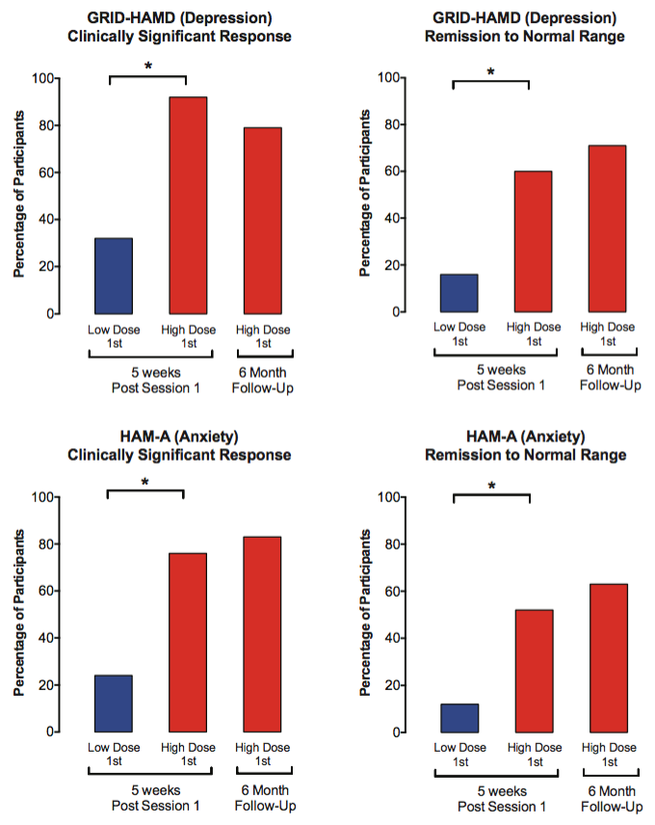
Gráfico que muestra el porcentaje de participantes que mejoraron en las medidas de depresión y ansiedad, a las cinco semanas y a los seis meses, en el estudio de Johns Hopkins. (Revista de Psicofarmacología)
El estudio de la Universidad de Nueva York fue muy similar, pero sólo contó con 29 participantes y utilizó la niacina, una vitamina, como placebo. (A mitad del experimento, los participantes cambiaron de grupo.) También incluía un componente de psicoterapia más formal, en el que los participantes hablaban de sus viajes. Ese estudio descubrió igualmente que la psilocibina tenía efectos inmediatos y duraderos. Seis meses después del tratamiento, entre el 60 y el 80 por ciento de los participantes observaron mejoras en diversas medidas de depresión y ansiedad, y el 70 por ciento lo consideraron una de las cinco experiencias más significativas de su vida.
“Lo más sorprendente para mí es que esto realmente funcionó. Yo era muy escéptico”, dijo Ross, autor principal del estudio de la NYU. Antes del tratamiento, algunos de los participantes lloraban y temblaban cuando hablaban de su cáncer. Pero “en el momento en que reciben psilocibina, su angustia disminuye. Eso es muy novedoso en psiquiatría, tener un medicamento que funcione inmediatamente para la depresión y la ansiedad y que pueda durar tanto tiempo”
Los investigadores no están seguros de cómo funciona exactamente la psilocibina, un problema bastante común en los fármacos dirigidos a la química del cerebro. La psilocibina parece aquietar el córtex prefrontal, una parte del cerebro en la que se ha asociado una mayor actividad con la depresión. También podría estar actuando sobre el uso cerebral del glutamato, un neurotransmisor que afecta al aprendizaje y la memoria. Ross dijo que lo que podría estar ocurriendo es una especie de “TEPT inverso”: un recuerdo profundamente positivo que afecta a los participantes durante meses, de forma muy parecida a como lo haría un trauma grave en el trastorno de estrés postraumático.
También es posible que el puro misticismo de la experiencia fuera suficiente para provocar un cambio de humor. “Hay una sacralidad o una reverencia en esa experiencia… también va acompañada de un estado de ánimo positivo, en el sentido de una apertura de corazón, amor o benevolencia”, dijo Griffiths. Los participantes pueden tener la sensación de que “la experiencia es más real y más verdadera que la conciencia cotidiana de la vigilia”. Aunque los efectos de las drogas desaparecen al final del día, los recuerdos de estas experiencias y las atribuciones que se les hacen perduran” No es raro, dijo, que los participantes en el estudio digan que piensan en su experiencia con la psilocibina todos los días.
Desde entonces, Vincent ha tomado clases de arte, y se ha encontrado haciendo pinturas que incluían temas de algunas de sus visiones inducidas por la psilocibina. Sus anteriores sentimientos de ansiedad y depresión no han reaparecido, dijo. “Tengo la sensación de haber entrado en algo más grande que yo”, dijo Vincent. “Sentí que me conectaba con el universo” No parecía importar si los participantes eran religiosos.
En el estudio de Nueva York, la mitad de los participantes no eran creyentes, aunque no lo sabrías al escuchar algunos de sus comentarios después de la experiencia. Una participante, atea declarada, dijo que estaba “bañada en el amor de Dios” (Sigue siendo atea)
No hubo efectos secundarios negativos graves del tratamiento, lo que disipó la preocupación de que los pacientes de cáncer pudieran “mirar al vacío existencial y salir aún más temerosos”, como dijo Griffiths. Alrededor del 15% de los participantes de la Johns Hopkins tuvieron náuseas, y un tercio experimentó paranoia temporal y elevación de la presión sanguínea.
En el estudio de la Universidad de Nueva York, el 28% de los participantes desarrolló dolor de cabeza y el 17% se puso temporalmente ansioso. Sin embargo, los investigadores de la Universidad de Nueva York señalaron que desde principios de la década de 1990 se han administrado más de 2.000 dosis de psilocibina en entornos clínicos, y hasta ahora no se ha informado de problemas médicos o psiquiátricos duraderos.
Aun así, los investigadores de ambas universidades advirtieron que sus hallazgos no sugieren que la gente corriente deba experimentar con setas mágicas. Algunos grupos, como las personas con esquizofrenia, podrían descubrir que la psilocibina empeora su estado, y en las encuestas, una pequeña parte de las personas que afirman haber consumido setas mágicas dijeron que se pusieron a sí mismas o a otros en riesgo de sufrir daños físicos durante su viaje.
Los estudios iban acompañados de 10 editoriales, en su mayoría de apoyo, de expertos en psiquiatría, atención al final de la vida y otros campos médicos. El uso de la psilocibina “puede indicar que la medicina ha cerrado el círculo para adoptar el primer enfoque conocido para curar nuestras agonías humanas más profundas, “generando lo divino en nuestro interior”, escribió Craig Blinderman, director del Servicio de Cuidados Paliativos para Adultos y profesor del Centro Médico de la Universidad de Columbia.
Estos estudios se suman a las pruebas de que la psilocibina podría ayudar a las personas que luchan contra distintos tipos de problemas de salud mental intratables. Estudios más pequeños han insinuado la eficacia de la droga para tratar el alcoholismo, el trastorno obsesivo-compulsivo, la depresión resistente al tratamiento y el tabaquismo. También se ha descubierto que ayuda a cambiar la personalidad de las personas, haciéndolas más “abiertas”, es decir, imaginativas o de mente amplia. El estudio tiene implicaciones para los enfermos terminales que se plantean el suicidio asistido por un médico, una decisión que a veces está motivada por el tipo de temor existencial que la psilocibina alivia.
Sin embargo, aún faltan muchos años para que la psilocibina se convierta en un tratamiento prescrito para el pavor relacionado con el cáncer. Aunque los investigadores pueden adquirir psilocibina para estudios, sigue siendo ilegal, lo que añade un obstáculo adicional al proceso de desarrollo del fármaco.
“Las leyes actuales, que no se basan en pruebas, impiden la investigación mediante onerosos requisitos de almacenamiento y seguridad, la dificultad para obtener financiación y la casi imposibilidad de obtener realmente compuestos restringidos sin tener que producirlos sintéticamente a un gran coste”, escribieron los psiquiatras de la Universidad de Columbia Jeffrey Lieberman y Daniel Shalev en uno de los editoriales sobre la psilocibina.
En un artículo del New Yorker sobre el potencial curativo de la psilocibina publicado el año pasado, Michael Pollan escribió: “A medida que la guerra contra las drogas disminuye, los científicos están ansiosos por reconsiderar el potencial terapéutico de estas drogas.”
Sin embargo, la elección por parte del presidente electo Donald Trump del senador de Alabama Jeff Sessions, un firme partidario de las drogas, para dirigir el Departamento de Justicia, sugiere que la guerra contra las drogas podría no terminar tan pronto como algunos esperaban.
George Greer, director médico del Instituto de Investigación Heffter, que financió estos estudios, dijo que aún no tiene “total claridad” sobre lo que significan los recientes acontecimientos políticos para su trabajo con los reguladores.
“Lo que puedo decir es esto: Esperamos que la evaluación de la FDA sobre la psilocibina siga adelante”, dijo. “A medida que aumenten las pruebas de investigación sobre la seguridad y la eficacia de la psilocibina, creemos que la FDA querrá saber más, y el proceso para ayudar a los pacientes de cáncer con depresión y ansiedad seguirá avanzando”
Por ahora, los tratamientos con psilocibina por encima de lo normal se limitarán a personas como Vincent, que se apuntan a los estudios. Parafraseando el aforismo, es un buen remedio, si puedes conseguirlo. Unos meses después de su experiencia con la psilocibina, Vincent conducía en un día soleado y escuchaba música. Se encontró cantando alegremente. “Dios mío”, pensó, “¡soy feliz! Vuelvo a ser yo”