



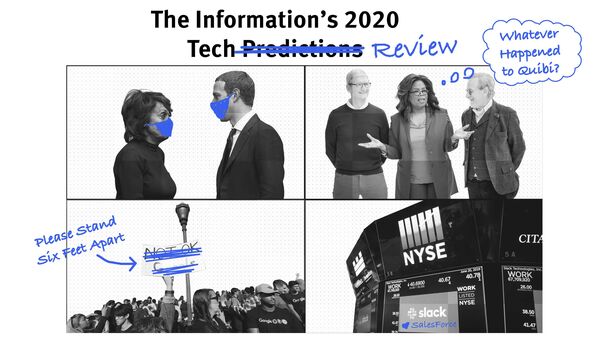
El año pasado, nuestros reporteros hicieron casi tres docenas de predicciones sobre la industria tecnológica en 2020. Nos perdimos la más grande, por supuesto: una pandemia global que causó la muerte de más de 1,6 millones de personas, una recesión y un cambio hacia el trabajo a distancia para la mayoría de los empleados de la tecnología.
Pero incluso cuando la pandemia dejó marcas indelebles en nuestra forma de vida, muchas de nuestras predicciones fueron en vano. Slack, que dijimos que sería adquirido, aceptó una adquisición por parte de Salesforce, uno de los compradores que mencionamos. Los fabricantes de coches auto-conductores comenzaron a consolidarse; Zoox vendió a Amazon por más de 1.000 millones de dólares. En otros casos, nuestros pronósticos se hicieron realidad debido a la pandemia -WarnerMedia está lanzando todas sus películas en su servicio de streaming, HBO Max, al mismo tiempo que llegan a los cines, por ejemplo.
El Takeaway
Calificamos cómo se han desarrollado nuestras predicciones para el 2020, desde las previsiones sobre la dirección del activismo corporativo hasta las grandes adquisiciones de software empresarial.
La exactitud de estas predicciones se debe en parte a factores impermeables a los eventos externos, como la dificultad técnica de desarrollar coches auto-conductores. También refleja lo preparada que estaba la industria tecnológica para aprovechar el trabajo y el entretenimiento a distancia, así como los desafíos que enfrentan las pequeñas empresas de software que compiten con los gigantes. Así es como nuestras predicciones resultaron. Para nuestra predicción del 2021.
Amazon
Dijimos: Amazon se verá obligada a tener en cuenta el hecho de que ahora se enfrenta al mismo escrutinio que otros gigantes de la tecnología. Los legisladores cada vez más envían preguntas a la compañía sobre su privacidad y prácticas comerciales, y algunos críticos de Ring la han descrito como una empresa de vigilancia.
Lo que sucedió: En julio, el CEO de Amazon, Jeff Bezos, hizo su primera aparición en el Congreso, para abordar las preocupaciones sobre el comportamiento anticompetitivo.
Calificación: A
Dijimos: Los empleados de la empresa que se envalentonaron este año para protestar por políticas de sostenibilidad más fuertes elegirán otro tema con el que presionar a Amazon.
Lo que sucedió: Los empleados corporativos de Amazon han protestado por una mejor protección de los trabajadores de los almacenes durante la crisis del Covid-19 y han pedido a la junta directiva de Amazon que aborde el racismo ambiental.
Calificación: A
-Paris Martineau
Medios de comunicación y entretenimiento
Dijimos: Uno de los grandes estudios de cine, como Warner Bros o Universal Studios, intentará lanzar algunas películas en servicios de streaming antes de estrenarlas en un cine.
Lo que sucedió: Los cierres de la pandemia ayudaron a que este pronóstico se hiciera realidad. Los estudios Universal de NBCUniversal lanzaron su “Gira Mundial de los Trolls” para alquilar en casa en vez de en los cines y Disney ha hecho lo mismo con algunas películas, incluyendo su gran remake de “Mulan”. Lo más notable es que a principios de este mes Warner dijo que pondrá todos sus estrenos en los cines el año que viene en su servicio de streaming al mismo tiempo que se estrenan en los cines.
Calificación: A+
Dijimos: AT&T cerrará su servicio de streaming, AT&T TV Now, antes llamado DirecTV Now.
Lo que pasó: AT&T TV Now sigue en marcha, pero AT&T está en conversaciones para vender una participación mayoritaria de su unidad de DirecTV, y algunas personas creen que el servicio de streaming de AT&T TV Now podría ser parte de ese acuerdo.
Calificación: D
Dijimos: El nuevo servicio de streaming de Disney, Disney+, superará ampliamente las suscripciones, llegando a más de la mitad de su objetivo para 2024 de 60 millones. Pero perderá algunos de esos clientes una vez que la promoción gratuita con Verizon expire en noviembre y tengan que empezar a pagar.
Lo que sucedió: Disney+ tiene actualmente 86,8 millones de suscriptores, por lo que fácilmente superó esa cifra de cinco años. No está claro cuántos de los suscriptores de Verizon han cancelado.
Calificación: B
-Jessica Toonkel y Tom Dotan
Google, Alphabet
Dijimos: La estructura de Alphabet será sacudida.
Lo que pasó: La estructura corporativa sigue en su lugar, aunque hubo algunos cambios. Google absorbió la unidad de Alphabet Jigsaw, una incubadora de tecnología que crea herramientas para frenar la desinformación en línea. Además, Alphabet cerró Makani, un esfuerzo para desarrollar energía eólica más asequible.
Calificación: C
Dijimos: La organización de los empleados se intensificará.
Lo que pasó: Los esfuerzos de organización en Google han sido silenciosos en comparación con años anteriores. El trabajo remoto extendido probablemente jugó un papel. Luego, a mediados de diciembre, el despido de Timnit Gebru, co-líder del equipo de ética de inteligencia artificial de Google, llevó a más de 2.300 empleados de Google a firmar una petición de protesta por el incidente.
Calificación: C
Dijimos: Google seguirá haciendo grandes adquisiciones a pesar de las investigaciones antimonopolio abiertas. Sabemos que está invirtiendo fuertemente en su negocio de nube, por lo que una compra en esa área, especialmente en aplicaciones de no-code y low-code (en las que hemos oído que Google tiene un interés particular), tendría sentido.
Lo que ha pasado: Google no hizo una adquisición de carpa como la que hizo en 2019 con Fitbit, pero sí compró un puñado de empresas de bajo perfil este año. Estas incluían la plataforma de creación de aplicaciones sin código AppSheet y la empresa de gestión de datos Actifio, valorada por última vez en 1.300 millones de dólares.
Calificación: B+
-Nick Bastone
Dijimos: Facebook hará una importante adquisición en el espacio de hardware.
Lo que pasó: Estábamos equivocados. En su lugar, la mayor adquisición de Facebook fue el inicio de la asistencia al cliente Kustomer por 1.000 millones de dólares. La preocupación por el escrutinio regulatorio probablemente frenó a la compañía de perseguir algunos acuerdos que le hubieran gustado, pero no cuenten un futuro acuerdo de hardware.
Calificación: D
Dijimos: Libra no se lanzará en 2020 sin cambios significativos en su funcionamiento.
Lo que sucedió: Esto resultó ser correcto. Después de haber planeado originalmente el lanzamiento de Libra a finales de 2020, Facebook debutará su proyecto de criptodivisa, ahora llamado Diem, el próximo año en sólo un puñado de países como una moneda digital respaldada únicamente por el dólar de los EE.UU.
Calificación: A
Dijimos: Las críticas sobre la desinformación, las políticas de publicidad y el comportamiento anticompetitivo se intensificarán.
Lo que sucedió: Cierto en todos los frentes. Facebook pasó gran parte del 2020 defendiendo su enfoque para manejar la desinformación y el discurso de odio, comenzando con un boicot de anunciantes y culminando con las elecciones de noviembre en los Estados Unidos. A mediados de diciembre, la Comisión Federal de Comercio demandó a Facebook por supuestas violaciones antimonopolio. Obtuvo algo de crédito por sus esfuerzos para controlar la desinformación sobre el coronavirus.
Calificación: A
-Alex Heath
El software como sector de servicios
Dijimos: Este será el año en que una gran compañía de tecnología finalmente comprará a Slack. Amazon, Google, Cisco y Salesforce serían los probables pretendientes.
Lo que pasó: Salesforce anunció un acuerdo de casi 28 mil millones de dólares por Slack en diciembre.
Calificación: A
Dijimos: Google comprará una empresa en la parte de aplicaciones de software de suscripción para ayudarla a entrar en una nueva área de negocios en la nube. Un posible candidato es Infor, que vende software para contabilidad, gestión de inventarios y otros procesos de negocio, dirigido a segmentos de la industria como la salud y los servicios financieros.
Lo que sucedió: Aunque Google no compró una empresa como Infor (que compró Koch Industries), sí adquirió dos pequeñas empresas, StratoZone y Cornerstone Technologies, que ayudan a otras empresas a hacer el cambio a proveedores de computación en nube. Google también adquirió Actifio, que ayuda a las empresas a gestionar sus datos, y AppSheet, que permite a los no codificadores crear aplicaciones.
Calificación: C
Dijimos: AWS puede lanzar su tan esperado servicio sin código, que permite a los no desarrolladores de las empresas construir aplicaciones que utilicen datos corporativos.
Lo que sucedió: Esto se hizo realidad en junio con el lanzamiento de Amazon Honeycode, un servicio que permite a los no codificadores construir aplicaciones web y móviles, confirmando nuestro informe de enero de 2018.
Calificación: A
Dijimos: Microsoft comenzará a reportar una cifra de ventas anualizada para sus servicios de nube Azure y aplicaciones como Office 365.
Lo que sucedió: Esto no sucedió. Microsoft continuó reportando los ingresos de Azure como parte de su segmento de Nube Inteligente, que también incluye productos de servidores y bases de datos que los clientes ejecutan en centros de datos privados.
Calificación: D
Dijimos: El fundador y co-director general de Salesforce, Marc Benioff, dejará el cargo en 2020, convirtiéndose en presidente ejecutivo, para poder centrarse más en los temas sociales.
Lo que sucedió: No. En lugar de ello, Benioff asumió un papel aún más activo en la compañía durante la pandemia y diseñó su viejo sueño de sustituir el correo electrónico para los clientes de Salesforce por el acuerdo para Slack. Y fue el co-director general Keith Block quien dejó la compañía.
Calificación: D
-Kevin McLaughlin
Regulación tecnológica
Dijimos: El Departamento de Justicia concluirá sus investigaciones antimonopolio sobre las empresas de tecnología y decidirá si sigue adelante con una demanda.
Lo que sucedió: El Departamento de Justicia y un grupo de estados presentaron una demanda antimonopolio contra Google en octubre, alegando que la empresa utilizó ilegalmente su dominio del mercado para proteger los monopolios de búsqueda y publicidad.
Calificación: A
Dijimos: La Comisión Federal de Comercio concluirá su investigación sobre las adquisiciones de tecnología del pasado.
Lo que sucedió: La FTC presentó una demanda antimonopolio contra Facebook a mediados de diciembre, alegando que la empresa había utilizado una estrategia de adquisición de rivales en ciernes para eliminar injustamente la competencia, lo que llevó a menos opciones para los consumidores. La FTC aún está investigando las pasadas adquisiciones de Amazon, Apple y Microsoft.
Calificación: A-
Dijimos: Los EE.UU. harán de la localización de datos, el empuje de los gobiernos extranjeros para hacer que las empresas estadounidenses almacenen los datos de los usuarios en sus países, un tema en las conversaciones comerciales.
Lo que sucedió: Esta predicción se dio vuelta de cabeza. La administración Trump exigió que TikTok se vendiera a un propietario estadounidense, diciendo que tal arreglo era necesario para asegurar que el gobierno chino no pudiera acceder a los datos de los ciudadanos estadounidenses.
Calificación: C
Dijimos: La tecnología seguirá ganando en cuestiones de impuestos y comercio pero perdiendo en cuestiones de parcialidad, antimonopolio y privacidad.
Lo que pasó: Los impuestos y el comercio han sido una mezcla. Francia ha suspendido la recaudación de sus nuevos impuestos digitales mientras continúan las negociaciones internacionales. Mientras tanto, la inmunidad legal que protege a las compañías tecnológicas de demandas por contenido publicado por los usuarios está bajo constante ataque, Google y Facebook son ahora acusados en demandas federales antimonopolio, y la FTC acaba de anunciar una nueva y amplia investigación sobre la privacidad.
Calificación: B
Apple
Dijimos: El servicio de video-streaming de Apple, Apple TV+, no logrará atraer a más de 10 millones de suscriptores en su primer año. El paquete de música-noticias-televisión que se espera que Apple ofrezca atraerá sólo a un pequeño número de suscriptores.
Lo que sucedió: Antes de la pandemia, el Apple TV+ había ganado alrededor de 10 millones de suscriptores, pero sólo la mitad estaban activos, según un informe de Bloomberg en febrero. Muchos servicios de streaming despegaron durante la pandemia, por lo que es posible que los suscriptores hayan superado los 10 millones desde entonces. Sin embargo, dado que Apple ofreció un año de suscripción gratuita a cualquiera que comprara un iPhone u otro hardware, es difícil saber cuántos de sus suscriptores están pagando o cuántos se quedan, dada su programación relativamente limitada.
Calificación: B
-Tom Dotan
El mercado de la OPI de la tecnología 2020
Dijimos: La SEC dará luz verde a una forma de que las empresas obtengan nuevo capital cuando salgan a bolsa.
Lo que pasó: El NYSE y el Nasdaq presentaron propuestas de reglas que permitirían recaudar capital en relación con las cotizaciones directas, pero las propuestas aún están siendo consideradas y no han sido aprobadas.
Calificación: B
Dijimos: Los bancos presionarán a las empresas para que las estructuras de gobierno que mantienen a los fundadores y directores generales sean más responsables.
Lo que sucedió: El resultado contrario fue que el fervor por las ofertas públicas iniciales de tecnología animó a más empresas a salir a bolsa. Para extender el control de los fundadores sobre sus empresas, los consejos de administración acordaron una proliferación de estructuras accionarias de doble clase, acuerdos de voto de los fundadores y, en el caso de Palantir, una estructura de gobierno bizantina que favorecía a las personas con información privilegiada de la empresa.
Calificación: D
Dijimos: Las empresas que se espera que salgan a bolsa (Airbnb, DoorDash, Casper y así sucesivamente) se apresurarán a hacerlo en la primera mitad del año para adelantarse al ruido y la incertidumbre de las elecciones de 2020.
Lo que sucedió: El vendedor de colchones online Casper salió a bolsa antes de que la pandemia interviniera y el mercado de valores se derrumbara en marzo. Después del rebote del mercado de valores en junio, una serie de ofertas públicas iniciales surgieron a finales del verano y de nuevo poco después de las elecciones presidenciales de EE.UU..
Calificación: C
-Ross Matican
Capital de riesgo
Dijimos: Las valoraciones bajarán en el mercado de arranque.
Lo que pasó: Pasó lo contrario. La pandemia aumentó el interés en la tecnología, elevando los niveles de efectivo disponibles para los capitalistas de riesgo. Las valoraciones se dispararon cuando los inversores compitieron por acuerdos, a veces hasta 100 veces los ingresos de una empresa.
Calificación: D
Dijimos: Las empresas de venta al por menor y las de venta directa al consumidor estarán bajo una presión cada vez mayor. Empresas como Casper y Hims se enfrentarán a los costes de producción.
Lo que sucedió: La pandemia ayudó a que esto se hiciera realidad. A principios de 2020, muchas empresas de venta directa al consumidor tuvieron dificultades para satisfacer la demanda de los clientes, ya que los cierres globales obstaculizaron la producción. Algunos se recuperaron cuando los consumidores se volcaron cada vez más al comercio electrónico, aunque Casper ha seguido luchando.
Calificación: A
Dijimos: Los fundadores obtendrán términos menos atractivos tras la debacle de WeWork.
Lo que pasó: Esto no fue realmente el caso. Con mucho capital en marcha, los fundadores que lideran las empresas competitivas han estado generando interés de los inversores y pueden exigir los términos que quieran.
Calificación: C
-Zoe Bernard
Viajes y bienes raíces
Dijimos: Airbnb esperará hasta el tercer trimestre para hacerlo público. Mientras que algunos asesores e inversores quieren que la compañía sea la primera en salir a bolsa en 2020, ha sido más el estilo del CEO Brian Chesky de posponer una oferta pública hasta el último momento posible.
Lo que sucedió: Aunque Airbnb tenía su prospecto de oferta pública inicial casi listo para presentarlo a principios de marzo, la pandemia retrasó sus planes hasta este mes. El momento jugó a favor de los inversores de Airbnb – un pequeño consuelo para los 1.800 empleados y cientos de contratistas que la compañía dejó ir en la primavera.
Calificación: B
Dijimos: WeWork pasará el año trabajando para un cambio de rumbo bajo la supervisión de SoftBank.
Lo que pasó: Esto sucedió, y WeWork sigue siendo una empresa de SoftBank. Lo que no preveíamos era la pandemia, que ha detenido la recuperación de la empresa. En el tercer trimestre, quemó otros 500 millones de dólares en efectivo y vio disminuir sus ingresos.
Calificación: B
Dijimos: Los grandes inversores inmobiliarios como Starwood Capital Group, Equity Office Properties y Brookfield profundizarán en la oficina flexible o el espacio de trabajo conjunto comprando empresas como Industrious, Convene y Knotel.
Lo que sucedió: Nada de esto sucedió. Las tres empresas de arranque despidieron personal en la primavera en medio de los cierres de oficinas nacionales. Y los grandes propietarios de oficinas tienen cosas más importantes de las que preocuparse, a saber, hacer que sus inquilinos paguen alquiler, que tratar de acaparar el mercado de compañeros de trabajo que pierde dinero.
Calificación: D
-Cory Weinberg
Vehículos Uber y autónomos
Dijimos: Uber se reducirá con más despidos o con la disminución de nuevos negocios. Si el crecimiento se ralentiza demasiado en el negocio de la venta ambulante, las acciones podrían hundirse más de lo que lo han hecho. Eso pondría en peligro el trabajo del CEO Dara Khosrowshahi. En los Estados Unidos, la segunda empresa de “ride-hailing”, Lyft, también reducirá su plantilla para apaciguar a los accionistas y alcanzar un flujo de caja positivo más pronto que tarde.
Lo que sucedió: Uber y Lyft redujeron su plantilla tras el inicio de la pandemia, y Uber abandonó varios negocios nuevos para centrarse en sus ofertas principales. Pero el trabajo de Khosrowshahi no está en peligro, porque el negocio de entrega de alimentos a restaurantes de Uber creció mucho más rápido y perdió menos dinero al beneficiarse de que los restaurantes cerraran sus comedores. Las acciones de Uber se han disparado un 73% este año y ahora están muy por encima del precio de la oferta pública inicial de 2019.
Calificación: B
Dijimos..: Los promotores de automóviles auto-conductores comenzarán a consolidarse. Uber y Lyft se desprenderán de sus brazos de desarrollo de vehículos de auto-conducción. Mientras tanto, Waymo se verá obligado por su empresa matriz Alphabet a buscar inversores externos para asumir sus costos de operación de medio billón de dólares al año.
Lo que sucedió: Además de la venta de Zoox, en diciembre Uber descargó su unidad de auto-conducción a Aurora Innovation en un acuerdo que valoró la unidad de Uber en 3,6 mil millones de dólares y le dio a Uber una participación minoritaria en la entidad combinada. También acertamos con el pronóstico de Waymo. Recaudó 3 mil millones de dólares de inversionistas externos, lo que debería cubrir sus costos por lo menos durante varios años.
Calificación: A
-Amir Efrati
—
